
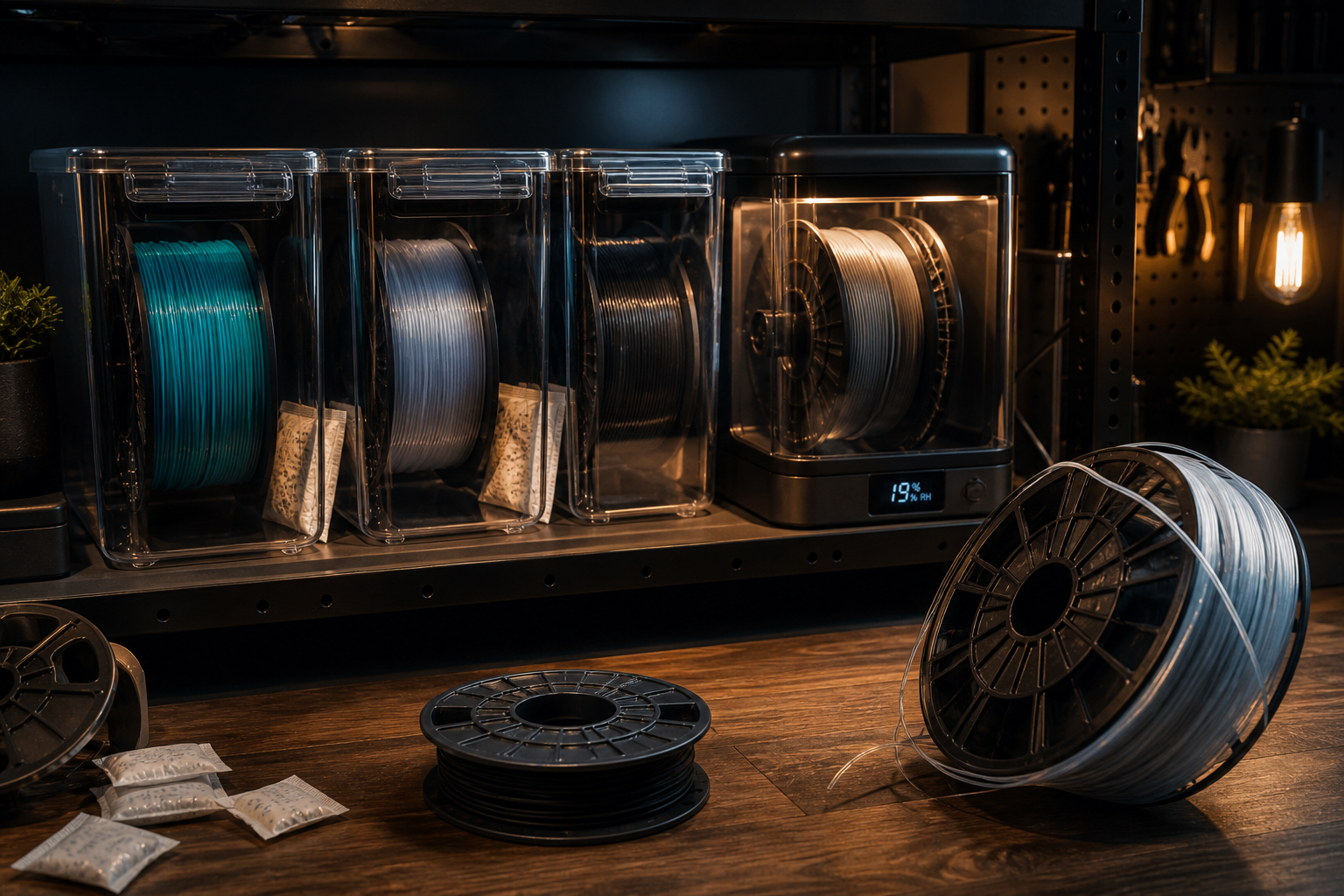
In Egypt, filament fails quietly. A sealed-looking spool left on a shelf through a humid week can print with stringing, weak layers, pops in the nozzle, and a surface that looks dusty or foamy. The printer is fine. The plastic drank water from the air.
This guide covers how to spot wet filament, how to dry it, and how to store it so your next print does not surprise you — especially with PLA, PETG, and TPU in Cairo and coastal cities.
Why humidity wrecks prints
Many filaments are hygroscopic: they absorb moisture. In the hotend, water turns to steam. That steam:
- Creates tiny voids between layers (weaker parts).
- Causes sputtering, zits, and stringing.
- Makes extrusion inconsistent even with a clean nozzle.
PETG, TPU, nylon, and PVA are thirsty. PLA is more forgiving but still suffers in Egyptian summers — especially cheap PLA stored open.
How to tell filament is wet
- Soft popping or crackling from the nozzle while printing.
- Sudden stringing on a profile that used to be clean.
- Rough, matte, or “foamy” extrusion instead of a smooth shiny bead (material-dependent).
- Brittle PLA that snaps when you bend a short length off the spool.
- Under-extrusion that improves after drying — the classic confirmation test.
If quality dropped over days without changing settings, dry the filament before you rewrite your whole slicer profile.
Drying temperatures and times (practical ranges)
Use a filament dryer when you can. A kitchen oven works only if it holds a stable low temperature — many ovens overshoot and warp the spool. When in doubt, lower and longer is safer than hotter and shorter.
- PLA: about 40–50°C for 4–6 hours (longer if very wet).
- PETG: about 60–65°C for 4–8 hours.
- TPU: about 40–55°C for 4–8 hours (check your brand; soft TPU can deform if too hot).
- ABS/ASA: about 70–80°C for 4–6 hours.
- Nylon: often 70–80°C+ and longer; treat nylon as “dry or do not bother printing.”
After drying, print soon or move the spool straight into a dry box. Leaving it on the table overnight undoes the work in humid weather.
Storage that works in real apartments
- Sealed box + desiccant — airtight plastic boxes with rechargeable silica gel packs. Cheap and effective.
- Dry box with a feed hole — print while the spool stays dry. Best for PETG/TPU multi-hour jobs.
- Vacuum bags — good for long-term storage of spools you rarely use. Re-seal with fresh desiccant.
- Do not trust the cardboard box alone — it is not a moisture barrier once opened.
Keep desiccant orange/blue indicators honest: when saturated, recharge or replace. A box full of dead desiccant is just a humid aquarium for filament.
Printing habits that reduce moisture damage
- Only unseal the spool you will use this week.
- For overnight PETG/TPU jobs, feed from a dry box.
- Label spools with open date and last dry date.
- If a print fails with classic wet symptoms, dry first — then change temperature or retraction.
Buying filament in Egypt: small quality checks
- Prefer spools in real sealed plastic, not only a loose cardboard sleeve.
- Ask sellers how it was stored (AC room vs open shop shelf through summer).
- Buy mid-size quantities you will finish; a “deal” on five wet spools is not a deal.
- After purchase, dry once and store properly — assume shipping humidity happened.
When drying is not enough
Old PLA that is yellowed, extremely brittle, or contaminated with dust may never print well. Recycle it as practice scrap or discard it. Do not blame the printer for dead filament.
If you need a reliable part this week and your only spool is suspect, order the print from a maker on Souq3D who already keeps dry stock. For PETG enclosures and TPU gaskets, dry filament is half the job.
A simple weekly routine
- Check desiccant color in every storage box.
- Dry any spool that will run a long job tomorrow.
- Return open spools to sealed storage the same day you finish.
- Keep one “known dry” PLA spool for calibration when troubleshooting.
Humidity is not a mystery setting in the slicer. Treat filament like food that spoils in open air — seal it, dry it, and your “sudden” print problems get a lot quieter.



Comments (0)
No comments yet. Be the first to share your thoughts.