
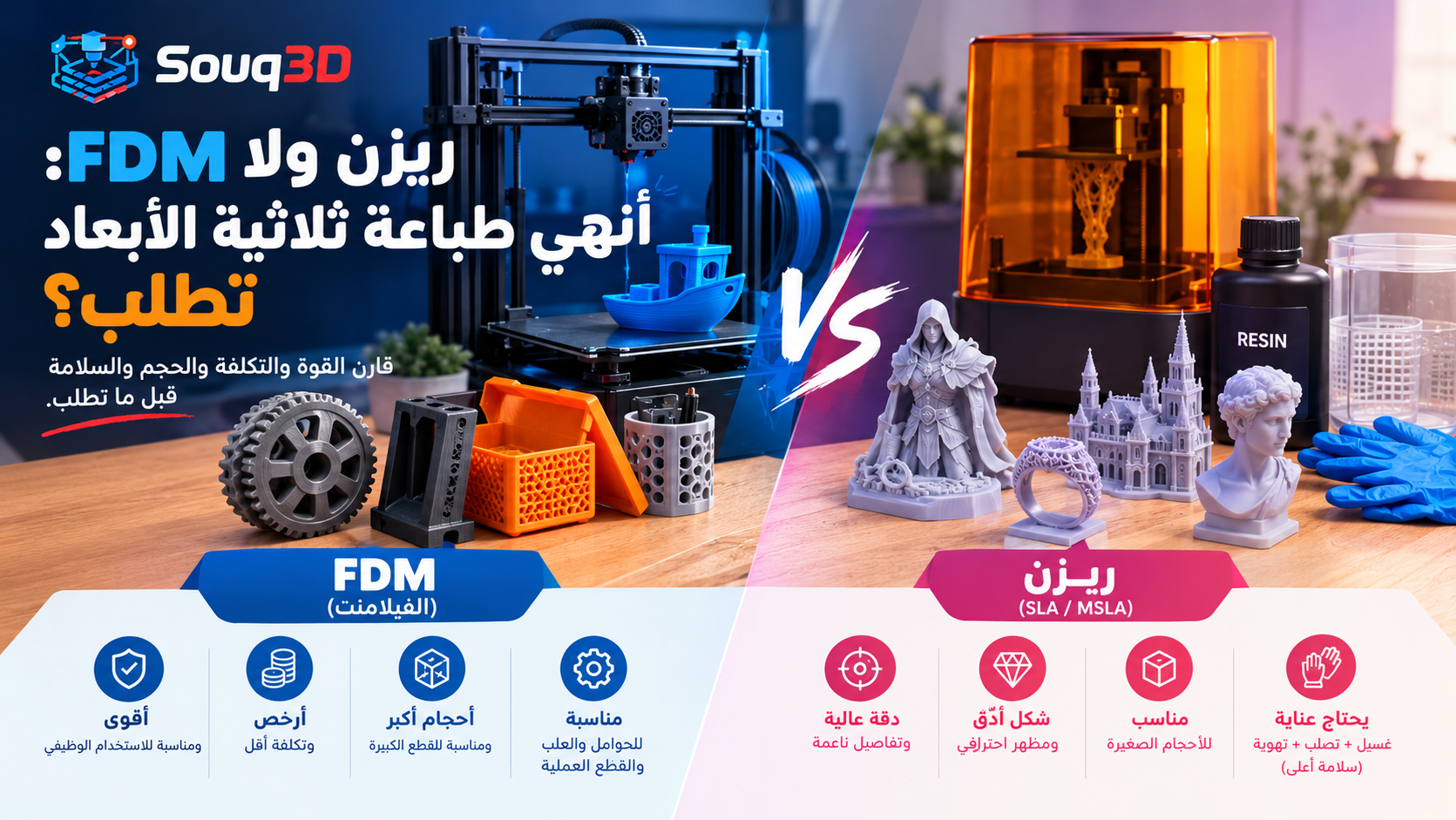
Short answer: Choose FDM (filament) for functional parts, brackets, enclosures and anything large or cheap. Choose resin (SLA/MSLA) for small, highly detailed items such as miniatures, jewelry masters, dental-style models and smooth prototypes. Resin looks sharper but is more brittle, needs washing and curing, and the liquid resin needs gloves and ventilation. If you are unsure, tell the maker what the part does and how big it is, and let them pick.
Both technologies turn a digital file into a physical object, but they behave very differently. Picking the wrong one is the most common reason a client receives a part that looks great and snaps in the first week, or a bracket that is the right shape but covered in layer lines.
How they work, in one minute
- FDM melts plastic filament and draws the part layer by layer through a nozzle. Typical layers are 0.1–0.3 mm.
- Resin (MSLA/SLA) cures liquid photopolymer with UV light, layer by layer, at 0.025–0.1 mm. The part is lifted out of a vat, washed in alcohol, then cured under UV.
Where FDM wins
- Strength and toughness. PETG, ABS/ASA and nylon survive drops and bending. See our broken parts guide.
- Size. Build volumes of 220–350 mm are common; resin printers are usually much smaller.
- Cost. Filament is cheaper per gram and there is no wash/cure step, so quotes are lower.
- Material choice. Flexible TPU, heat-tolerant ASA, carbon-filled and many colors.
Where resin wins
- Fine detail. Faces on miniatures, thin text, small gears, textures.
- Smooth surfaces. Almost no visible layers, so painting and finishing take far less sanding.
- Small precise parts. Jewelry patterns, small fittings and display models.
Where resin is a poor choice
- Standard resin is brittle. Thin snap-fits and clips crack. Tough or ABS-like resins help but cost more.
- Parts yellow and weaken under long sun exposure unless coated.
- Large solid parts use a lot of expensive resin unless hollowed with drain holes.
- Post-processing is messy: isopropyl alcohol, UV curing, and used resin that must not go down the drain.
Side-by-side
- Detail: FDM — Good; Resin — Excellent.
- Strength: FDM — Good to very good; Resin — Fair (brittle).
- Max size: FDM — Large; Resin — Small to medium.
- Surface: FDM — Visible layer lines; Resin — Smooth.
- Cost per part: FDM — Lower; Resin — Higher.
- Outdoor use: FDM — ASA/PETG fine; Resin — Needs coating.
Safety you should know about
Uncured resin irritates skin and can cause allergic reactions. Makers should work with nitrile gloves and ventilation, and finished, fully cured parts are safe to handle. Do not order resin parts for food contact or toys for small children unless the maker confirms the resin is rated for it. FDM is not automatically food safe either; see our post-processing guide.
Quick decision guide
- Functional bracket, case, jig, hook → FDM (PETG or ASA).
- Miniature, figurine, jewelry pattern, tiny detailed prototype → resin.
- Big prop or cosplay armor → FDM, then sand and paint.
- Looks matter and the part is under about 10 cm → resin.
Cost: what to expect
FDM is usually the cheaper route for anything bigger than a matchbox, because filament is cheap and prints run unattended. Resin cost grows quickly with volume: a solid 10 cm part uses a lot of resin, while the same part hollowed out and drained costs far less. Add the time the maker spends washing, curing and removing supports, and a small resin part can cost more than a larger FDM part. Ask for both quotes when the part is under about 10 cm and looks matter.
Accuracy and tolerances
Resin printers hold small features better: a 0.3 mm pin or a thin engraved line is realistic. FDM is accurate enough for most fits, but holes print slightly small and corners round off. If two printed parts must fit together, tell the maker the clearance you need, 0.2 mm for FDM and 0.1 mm for resin is a common starting point, and plan a test fit.
Finishing and painting
An FDM part needs filling, sanding and primer to hide layer lines, which is fine for large props and costs mostly time. A resin part is nearly smooth straight from the vat, so a light sanding and primer give a very clean paint finish. For display models that are going to be painted, resin saves hours. For functional parts that nobody will look at closely, FDM is simply enough.
Real examples
- Motorcycle phone mount: FDM in PETG or ASA. It faces heat, vibration and sun, and resin would crack.
- Wedding cake topper with names: resin. Thin letters and a smooth surface matter more than strength.
- Electronics enclosure, 15 cm: FDM. Large, needs screw bosses, and must survive being handled.
- Jewelry ring pattern: resin, usually a castable type. Detail is the whole point.
- Board game miniatures, a set of 20: resin, printed in batches to keep the price reasonable.
Common mistakes
- Ordering resin for a part that will be bent, dropped or clipped on. It will snap.
- Ordering FDM for a tiny detailed figure and being disappointed by the surface.
- Leaving resin parts in the sun without a coating, so they yellow and weaken.
- Not mentioning the intended use, so the maker picks the cheapest process that technically works.
What to include in your request
Four lines are enough: the size in millimeters, what the part does, whether it will be painted or shown, and where it will live (indoors, outdoors, in a car). With that, a maker can recommend a process and material without guessing.
Order the right one
When you post a request on Souq3D, write the size, what the part does, and whether looks or strength matter more. Makers will answer with the process they recommend, and you can compare prices with the cost calculator first.
Comments (0)
No comments yet. Be the first to share your thoughts.